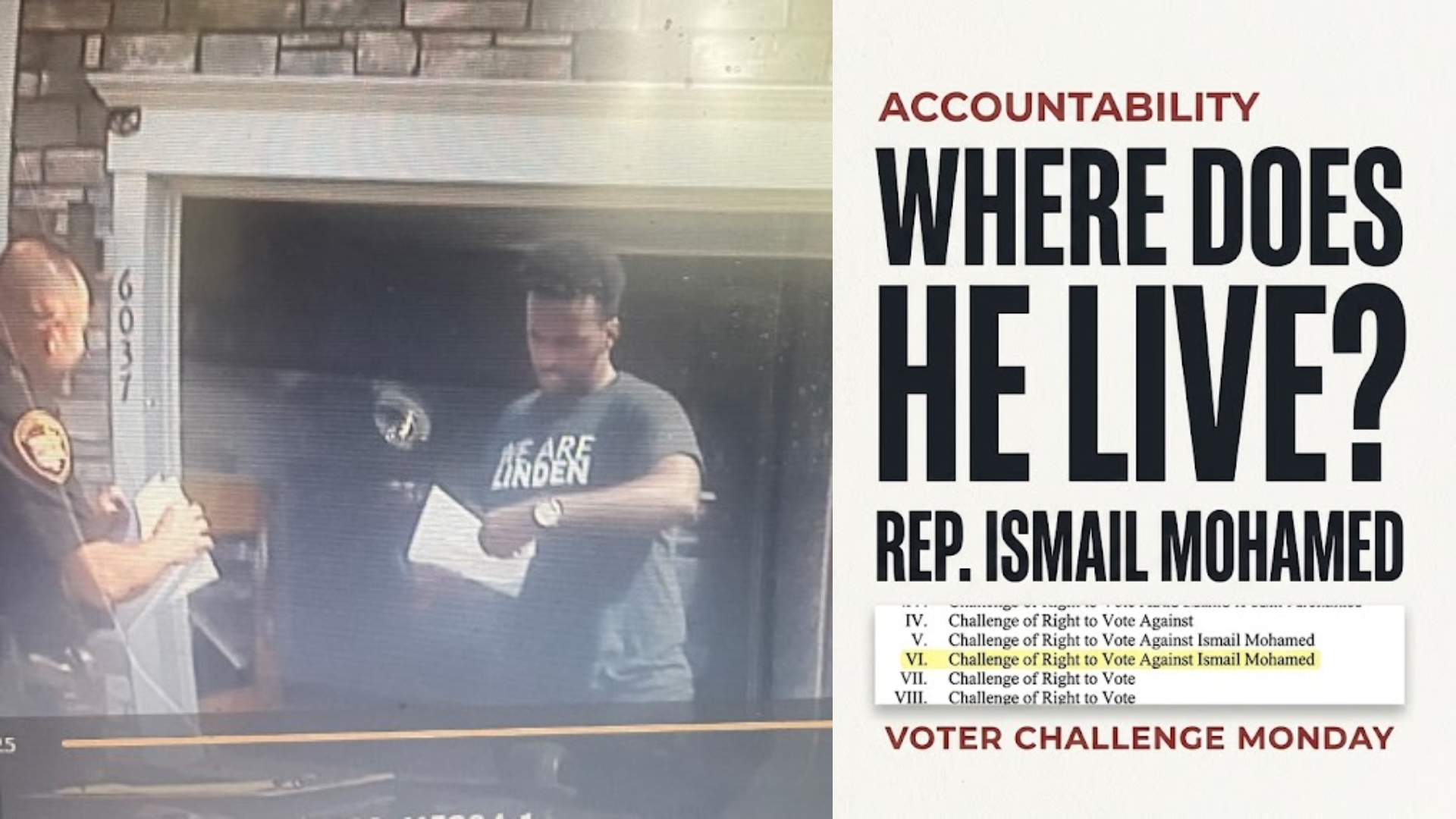
The Board didn’t decide where Rep. Ismail Mohamed lives. The challenge is coming back.
Franklin County election officials did not reach the underlying residency dispute Monday after Mohamed changed his voter-registration address. Former state Rep. Bernadine Kennedy Kent says she plans to file another challenge.
By Kin Newsroom

The hearing came Monday.
The answer didn’t.
The Franklin County Board of Elections did not resolve the underlying question that brought Ohio Rep. Ismail Mohamed before election officials:
“Where does he legally live?”
Instead, the voter-registration challenge involving the Democratic state representative is headed for another round after Mohamed changed the Franklin County address associated with his voter registration.
Former state Rep. Bernadine Kennedy Kent, Mohamed’s Republican opponent for Ohio House District 3, says she plans to file another challenge directed at his current registration.
And for Kin readers, that turn should sound familiar.
Kent told Kin two days before Monday’s meeting that Mohamed had changed his voter-registration address after being served and that she expected the original challenge involving his previous Overlook Ridge registration would have to be filed again.
“We will have to refile,” Kent told Kin Saturday.”
That is now where the dispute is headed.
Monday did not settle the residency question
The Franklin County Board of Elections’ official Sept. 14 agenda listed the matter as “Challenge of Right to Vote Against Ismail Mohamed.”
But Monday did not result in a decision on the evidence underlying the dispute over Mohamed’s residence.
That distinction matters.
The original challenge concerned the Franklin County voter registration associated with 1753 Overlook Ridge Dr.
Kent told Kin before the meeting that Mohamed changed his voter-registration address after the challenge was filed.
Because the registration being challenged changed, Kent said she expected to pursue the issue through another filing rather than have the Board decide the old registration.
So Monday was not a determination that Mohamed lives in Franklin County.
It was not a determination that he lives in Delaware County.
And it was not a rejection of the evidence Kent assembled.
The central residency question remains unresolved.
Kent told Kin this was coming
During an on-the-record interview Saturday, Kent said her attorney, Curt Hartman, had requested subpoenas connected to the voter challenge.
Kent told Kin that service was attempted at both Mohamed’s then-listed Franklin County address and the Delaware County property he co-owns.
She said the Franklin County apartment was found vacant and that Mohamed and Hoda Adheys were served at the Delaware County property.
Kin also obtained an image from sources who identify the man shown in an open garage as Mohamed.
The image appears to be a screenshot from in-car law-enforcement video and shows a man wearing a black “WE ARE LINDEN” T-shirt holding papers while a uniformed officer stands facing him.
Kin has not independently verified the original video or official return of service.
Kent then told Kin something else:
She said Mohamed changed his voter-registration address the day after he was served.
Kin had not independently obtained the complete voter-registration history establishing that timeline before its first story was published.
But Kent predicted the procedural consequence before Monday’s meeting.
The original challenge, she said, would no longer address Mohamed’s current registration.
The evidence behind the challenge has not disappeared
Changing a voter-registration address does not erase the records that prompted Kent’s challenge.
The challenge materials reviewed by Kin lay out a documentary timeline stretching from Mohamed’s Delaware County property purchase to his 2026 declaration of candidacy.
According to the Board candidate file cited in the challenge, Mohamed filed his Declaration of Candidacy and Nominating Petition for Ohio House District 3 on Feb. 3, 2026.
The filing listed:
“1753 Overlook Ridge Dr., Columbus, Ohio 43219”
as his voting residence.
The declaration was signed subject to the election-falsification warning printed on the form.
But Kent’s challenge points to a separate government record from several months earlier.
An Oct. 7, 2025 Real Property Conveyance Fee Statement of Value and Receipt — known as a DTE 100 — identifies “MOHAMED ISMAIL ALI & ADHEYS HODA” as the grantees of a residential property at 6037 Heather Ridge Dr. in Delaware County.
The challenge materials state the single-family home was purchased for $587,000.
Ownership of a second property does not itself establish where someone legally resides.
But the challenge points to another portion of the conveyance paperwork.
The form says the Delaware house would become a principal residence
According to the challenge packet reviewed by Kin, the “Yes” box was checked on the October 2025 DTE 100 when the form asked whether the Delaware County property would become the grantees’ principal residence by Jan. 1 of the following year.
That representation is central to Kent’s argument.
Months later, Mohamed’s February declaration of candidacy listed the Overlook Ridge address in Franklin County as his voting residence.
Those two records create a question for election officials — but they do not, by themselves, answer it.
Ohio election law says a person’s residence is the place where that person’s habitation is fixed and where the person intends to return when absent.
The law also recognizes that a person can temporarily leave a residence without losing it.
In other words, the legal question is not simply:
“Who owns which house?”
It is where Mohamed’s actual home was fixed and where he intended to return.
Delaware County tax records add another piece
Kent’s challenge also points to the tax treatment of the Delaware County property.
The materials reviewed by Kin say Delaware County Auditor records identify Mohamed and Adheys as the current owners and reflect an owner-occupancy credit of $103.13 for each half of the current tax year.
Owner-occupancy treatment is relevant because Ohio’s tax guidance connects that credit to a home occupied as a principal residence.
Again, that does not automatically determine Mohamed’s voting residence.
It is another government record Kent wants election officials to consider alongside the conveyance paperwork, voter registration, and candidate filing.
His financial disclosure creates another question — with an important caveat
Kent’s challenge also cites Mohamed’s 2025 Financial Disclosure Statement filed with the Joint Legislative Ethics Committee on April 6, 2026.
Under the real-estate section, Mohamed reported:
“NONE.”
That fact requires context.
Ohio’s financial-disclosure instructions do not require a lawmaker to report a personal residence.
That means the “NONE” entry cannot simply be treated as evidence that Mohamed concealed a property.
Kent argues that when the disclosure is read alongside the Delaware County conveyance and owner-occupancy records, it is consistent with the Delaware house being treated as a personal residence rather than an investment property.
That remains the challenger’s argument — not a finding by the Board.
The challenge also mentions Home Depot and Value City Furniture as creditors listed on Mohamed’s disclosure.
Those entries do not establish what was purchased, where anything was delivered or whether the debts had any relationship to the Delaware County property.
Kin is not treating them as evidence of residency.
What a new challenge would do
Ohio law allows a qualified elector to challenge another registered voter’s right to vote.
The challenge must state its reasons and be signed under penalty of election falsification.
Once a challenge is filed, the Board reviews its records.
If those records are enough to resolve the matter, the Board may vote without a hearing.
If they are not, Ohio law requires a hearing at which the challenged voter may testify, call witnesses and be represented by counsel.
Subpoenas may also be issued.
A new filing against Mohamed’s current voter registration would restart that process around the address he now claims for voting purposes.
That means the next challenge could bring many of the same underlying records back before the Board — this time directed at the registration currently on file.
This is separate from Mohamed’s House seat
There is another important distinction.
A Franklin County voter-registration challenge is not itself a proceeding to remove Mohamed from the Ohio House.
Ohio law separately requires members of the General Assembly to remain residents of the districts they represent during their terms.
The Board of Elections proceeding concerns voter registration.
Any question involving whether Mohamed continues to satisfy the separate residency requirement for his legislative office carries its own legal and procedural issues.
Monday’s meeting did not decide that question either.
Mohamed has not answered Kin’s residency questions
Before Kin published its first investigation Saturday, Kin called Mohamed and followed up by text.
Kin asked him directly whether the Delaware County property is his principal residence.
Kin also asked whether he had been personally served there and, if so, what documents he received.
Mohamed did not respond before the earlier story was published.
Kin remains prepared to include his explanation of the residency records and Monday’s proceedings.
So we are back to the same question
Monday was supposed to put the residency dispute before Franklin County election officials.
Instead, the underlying question survived the meeting.
Kent says another challenge is coming.
The Delaware County house still exists.
The principal-residence representation cited in the challenge still exists.
The owner-occupancy record still exists.
Mohamed’s candidate paperwork listing a Franklin County voting residence still exists.
And none of those records received a final factual ruling on Monday.
So Kin will continue following the question that started this reporting:
“Where does Rep. Ismail Mohamed legally live?”
The next challenge may be where the Board finally has to answer it.
- Ismail Mohamed
- Bernadine Kennedy Kent
- Franklin County Board of Elections
- Ohio House District 3
- voter registration
- Delaware County
- Ohio politics
- Elections 2026
- residency