The Alarms Never Sounded. Five Years Later, Yenkin-Majestic Pleads Guilty.
The Columbus manufacturer pleaded guilty to federal negligent endangerment more than five years after an explosion killed Wendell Light, injured eight workers and sent a predominantly Black neighborhood into a years-long fight for answers.
· Updated
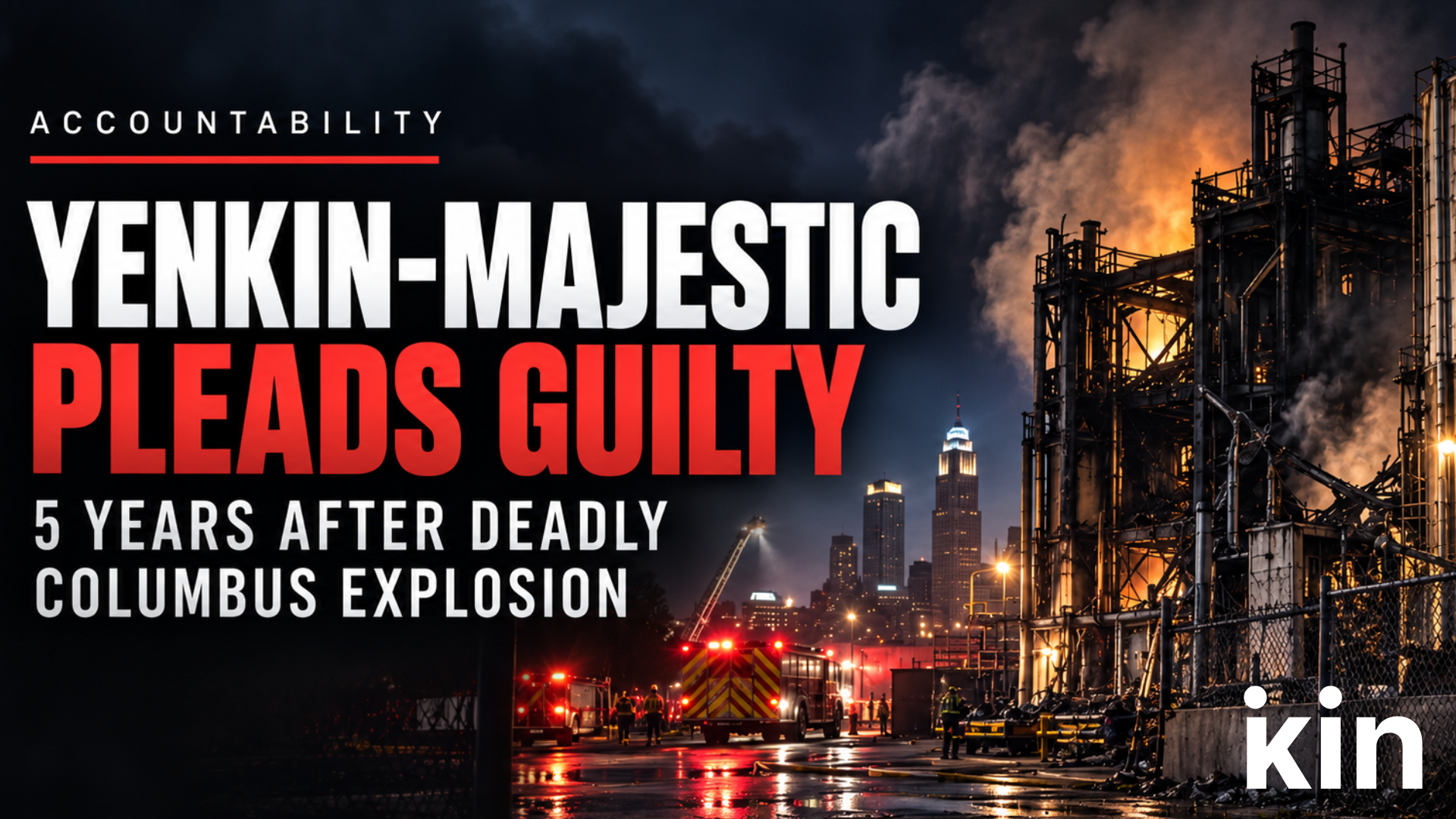
I had just put my head on the pillow when the house shook.
Then came the boom.
It was just after midnight on April 8, 2021.
I had only recently left our UnBossed Columbus newsroom studio for the night. The studio sat under the bridge less than a quarter-mile from the Yenkin-Majestic Paint Corporation plant on Leonard Avenue.
I lived about 1.25 miles up the street.
Then my phone started ringing.
I grabbed my car keys and my camera and headed back toward Leonard Avenue.
I was the first reporter on the scene.
Fire crews were pouring into the area. Smoke was rising into the night. Employees were emerging from what remained of the plant. Something had gone terribly wrong inside Yenkin-Majestic.
I started reporting.
Over the hours that followed, we would learn that workers had been injured, parts of the building had collapsed and one employee was missing.
His name was Wendell Light.
He was 44 years old.
Light, a press room supervisor, was eventually found dead beneath rubble inside the resin plant. Eight other employees were transported to hospitals. Federal investigators would later document burns, broken bones and other trauma among the injured workers; one employee ultimately required a leg amputation after being crushed beneath collapsed debris. More than 100 firefighters responded to a fire that burned for roughly 11 hours.
That night became the beginning of years of reporting by what was then UnBossed Columbus.
We reported on the explosion.
We reported on what residents were experiencing.
We reported on environmental concerns.
We followed the questions about air quality, chemical exposure, worker safety and what government agencies were — or were not — doing for the people who lived around the plant.
And through it all was one question that never really went away:
Who would be held accountable?
Five years later, we finally have part of the answer.
Yenkin-Majestic has pleaded guilty
Yenkin-Majestic Paint Corporation pleaded guilty this week in federal court in the Southern District of Ohio to negligent endangerment, a criminal charge stemming from the explosion that killed Light and severely injured other workers.
The U.S. Department of Justice announced the plea Friday, September 4.
Federal prosecutors say the company's actions — and its failures to act — created the manufacturing environment that resulted in death and severe injury.
That alone is a major development in a story Columbus has been living with since 2021.
But buried inside the federal case is a detail that makes what happened that night even harder to comprehend.
The gas detectors worked.
They detected the danger.
The alarms never sounded.
I heard the explosion from more than a mile away.
The workers inside the plant were never given an audible warning that the danger was already around them.
The failures began months before the explosion
What happened at 12:04 a.m. on April 8 did not begin at 12:04 a.m.
Federal investigators traced the disaster back months.
Yenkin-Majestic manufactured coatings and resins using large steel vessels known as kettles. In 2020, the company decided to modify one of those vessels, Kettle 3, by fabricating and installing a new access door called a manway.
The new manway was installed in December 2020.
According to federal prosecutors, Yenkin-Majestic never properly pressure-tested that new manway before returning Kettle 3 to service — despite the kettle having experienced high-pressure spikes.
Then came another warning.
The newly installed manway began leaking.
The company continued operating Kettle 3.
Instead of removing the vessel from service and resolving the underlying problem, prosecutors say Yenkin-Majestic installed a thicker gasket that it believed was made of Teflon.
It was actually silicone.
OSHA would later find that the company had improperly altered the kettle reactor vessel and returned it to service without ensuring that it could safely contain pressure.
The agency issued two willful and 33 serious safety violations, proposed $709,960 in penalties and placed Yenkin-Majestic in its Severe Violator Enforcement Program.
OSHA's conclusion was blunt: the explosion could have been prevented.
And the warning signs did not stop with the leaking manway.
OSHA found that the new manway had already failed during production on January 3, 2021 — roughly three months before the fatal explosion — and that the company failed to initiate the required incident investigation into that earlier leak.
The catastrophe Columbus saw in April had been preceded by a failure in January.
Kettle 3 stayed in service.
Then came the final two minutes
On the night of April 7 into the early morning of April 8, workers were producing resin in Kettle 3.
At 10:22 p.m., the kettle's agitator unexpectedly shut down.
The operator did not realize it had stopped. There was no active alarm telling him something was wrong.
Later that night, roughly 300 gallons of flammable solvent were added to the kettle while the agitator remained off. Instead of mixing into the hot resin as intended, the solvent formed a layer above it.
Around midnight, the agitator was switched back on.
The solvent suddenly mixed with the hot resin and rapidly vaporized.
Pressure inside Kettle 3 climbed.
The manway could not hold it.
At approximately 12:02 a.m., hot resin liquid and flammable solvent vapor began escaping from the vessel.
The vapor spread through the enclosed plant, forming a flammable cloud inside and outside the building.
Then the plant's gas monitors began detecting it.
According to the Chemical Safety Board, some of those monitors detected the solvent release roughly one minute after it began.
They even sent an email notification to someone off-site.
But they did not sound an audible alarm inside the facility.
Employees were not warned to evacuate. Some workers, inadequately trained to recognize a flammable vapor cloud, actually moved toward the hazard trying to determine what was happening.
At 12:04 a.m., just two minutes after the release began, the vapor cloud reached an ignition source.
The plant exploded.
Wendell Light never made it out
There were 21 Yenkin-Majestic employees on site that night.
After the explosion, employees began evacuating through a building that was burning and collapsing around them.
Some had to run through flames.
Firefighters rescued workers trapped inside the unstable wreckage. Eight injured employees were taken to hospitals.
Light remained missing.
When daylight came, crews continued searching.
He was eventually found on the second floor of the resin plant, partially covered by rubble. The Chemical Safety Board determined that he died from thermal injuries and inhalation of products of combustion.
He went to work that night.
He never came home.
That fact has to remain at the center of this story, because government reports can reduce catastrophes to equipment numbers, pressure ratings, regulatory codes and technical failures.
A man died.
Other workers left with life-changing injuries.
Families received phone calls no family wants.
And an entire neighborhood woke up to an industrial disaster unfolding outside their homes.
The explosion didn't stop at the factory fence
People around Yenkin-Majestic did not need a federal investigation to tell them something serious had happened.
They felt it.
Homes shook.
Nearby buildings were damaged.
A fire ignited at an adjacent commercial property.
The blast could be heard and felt across parts of Columbus.
And what followed raised another set of questions: What had just entered the surrounding environment?
The Chemical Safety Board later found that firefighting water runoff from the incident entered nearby Alum Creek through a storm drain.
Ohio EPA observed off-site impacts associated with the incident through at least April 11.
Yenkin-Majestic conducted air monitoring around the perimeter of the facility, while responders worked to vacuum contaminated runoff into tankers and install containment booms near storm drains.
For residents, however, the question was bigger than what was happening at the plant's property line.
They lived there.
Their children played there.
Their homes were there.
And the demographics surrounding Yenkin-Majestic made the environmental questions impossible to separate from questions of race and power.
The Chemical Safety Board later examined census data for the approximately one-mile area around the facility.
More than 33,000 people lived in those census blocks.
Fifty-six percent were Black.
About 30% lived below the poverty line.
That is not incidental context.
It is part of the story.
A predominantly Black community had to keep demanding answers
In the months and years after the explosion, residents continued asking what the incident meant for the air they breathed and the community surrounding the facility.
Our newsroom kept following those questions.
The issue became one of environmental justice: who bears the risk when industrial facilities operate alongside residential neighborhoods, whose concerns receive immediate attention after something goes wrong, and how long a community should have to fight for independent information about its own environment.
It would take more than two years after the explosion before Columbus City Council approved $189,000 for hyperlocal air-quality testing in the surrounding North Central community.
The city's own legislation acknowledged that residents had expressed urgent concerns about neighborhood air quality following what the ordinance called an “environmental event.”
The study was designed to measure pollution at the neighborhood level and compare the area surrounding Yenkin-Majestic with another section of Columbus.
Jennifer Keaton, a longtime resident of the neighborhood, later described the force of the blast to WOSU.
It shook the entire neighborhood, she said — so violently that a light fixture in her house that hadn't worked turned on.
That is what institutional reports can sometimes miss.
An “incident” on paper is a family waking up terrified in its house.
An “off-site impact” is somebody wondering what came through their neighborhood.
An “environmental event” is a community asking whether anybody with authority is going to tell them what they have been exposed to.
Those residents kept asking.
Investigators eventually answered another question
What happened inside Yenkin-Majestic?
By 2023, the U.S. Chemical Safety and Hazard Investigation Board had completed one of the most detailed examinations of the explosion.
Its conclusion went well beyond a freak accident.
Investigators found that Yenkin-Majestic failed to adequately ensure the mechanical integrity of the newly installed manway on Kettle 3.
The company lacked engineering controls that could have prevented solvent from being added while the agitator was off.
Its gas detection system did not effectively warn employees.
Workers had not been adequately trained to recognize the danger presented by a flammable vapor cloud.
And employees working around flammable chemicals were not universally required to wear flame-resistant clothing.
The CSB concluded that inadequate emergency preparedness contributed to the severity of what happened — including the failure to evacuate everyone in time and the absence of audible alarms warning employees that flammable vapor concentrations were spreading through the plant.
OSHA had already reached its own conclusion two years earlier.
Yenkin-Majestic could have prevented the tragedy had it followed industry standards and removed the compromised kettle from service.
Now the criminal justice system has added another finding to that record.
Guilty.
What the company admitted to
By pleading guilty to negligent endangerment, Yenkin-Majestic has moved this story beyond regulatory citations and investigative recommendations.
The company has now admitted criminal liability in federal court.
“When safety protocols aren't followed, pressurized equipment can cause terrible accidents like the tragedy at Yenkin in 2021”
The Justice Department said Yenkin-Majestic's actions and inactions created a manufacturing environment that resulted in death and severe injury.
Ohio Attorney General Andy Wilson put it more simply:
“Yenkin failed to keep its employees safe.”
The criminal investigation involved the U.S. EPA's Criminal Investigation Division, the Ohio Attorney General's Bureau of Criminal Investigation and Ohio EPA's Special Investigations Unit, with support from OSHA.
The defendant is the corporation.
The Justice Department's announcement did not identify an individual company executive as having been criminally charged.
And Friday's announcement did not include a final sentence.
So while the plea answers one question, it opens another.
What will punishment actually look like?
Five years later, every CSB recommendation is still open
There is another piece of this story that should not get buried beneath the guilty plea.
After its investigation, the Chemical Safety Board issued seven recommendations intended to prevent this kind of catastrophe from happening again.
Five went directly to Yenkin-Majestic/OPC Polymers.
As of September 2026, every one of those five remains open.
The CSB currently classifies each of the five company recommendations as “Open — Unacceptable Response/No Response Received.”
Those recommendations concern the same failures investigators identified after the explosion: mechanical integrity, engineering standards, plant design, flammable-gas detection and audible warnings, employee training and protective clothing.
Two additional recommendations issued to industry standard-setting organizations also remain open.
**Seven recommendations issued.
Seven recommendations still open.
Zero closed.**
That matters because a guilty plea and accountability are not necessarily the same thing.
A criminal case can end.
The conditions that created one can remain.
This story did not begin with a Justice Department press release
There is a tendency in journalism to treat each government announcement as a new story.
This one isn't.
Our newsroom began reporting on Yenkin-Majestic the night the plant exploded, when we operated as UnBossed Columbus.
The name of the newsroom has changed.
The responsibility hasn't.
Our original cameras documented what was happening when the smoke was still rising from Leonard Avenue.
Then came the questions from residents.
Then the OSHA findings.
Then the environmental concerns.
Then the fight for independent air-quality testing.
Then the Chemical Safety Board investigation.
Now comes the federal guilty plea.
Those aren't separate stories.
They are chapters of the same one.
And the value of having a newsroom rooted in a community is that we don't have to rediscover the history every time an institution issues another press release.
We remember.
What accountability means now
The Justice Department calls the plea a measure of accountability.
It is.
But it cannot be the final measure.
Accountability has to include what happens to Yenkin-Majestic at sentencing.
It has to include whether the safety recommendations born out of this disaster are actually implemented.
It has to include whether workers inside hazardous facilities are adequately protected.
It has to include whether the people living outside those facilities know the risks surrounding them.
And it has to include whether predominantly Black neighborhoods like the one surrounding Yenkin-Majestic have to fight for years before their environmental concerns receive sustained public attention.
Because North Central residents weren't imagining the danger.
Workers weren't exaggerating the consequences.
And what happened that night wasn't simply an unavoidable industrial accident.
OSHA said it could have been prevented.
The Chemical Safety Board documented a chain of failures.
And now Yenkin-Majestic has pleaded guilty in federal court.
Five years ago, I heard the explosion from my bedroom 1.25 miles away.
I grabbed my camera and drove toward it because that was the story happening in front of us.
What none of us standing on Leonard Avenue could see that night were the decisions inside the plant that had come before the blast: the altered kettle, the leaking manway, the inadequate pressure testing, the missing engineering controls and gas detectors that could recognize a growing cloud of flammable vapor but could not audibly warn the workers standing in its path.
We know much more now.
Wendell Light is still dead.
Workers still live with what happened to them.
The neighborhood still carries the history of that night.
Seven federal safety recommendations remain unresolved.
And now, finally, the company responsible for the plant has entered a guilty plea.
The alarms never sounded.
Five years later, accountability finally has.
The question now is how far it will go.

- Yenkin-Majestic
- Yenkin-Majestic Paint Corporation
- OPC Polymers
- Wendell Light
- North Central Columbus
- Environmental Justice
- Worker Safety
- OSHA
- Chemical Safety Board
- U.S. Department of Justice
- Ohio EPA
- Columbus
- Corporate Accountability
- Industrial Safety
If this reporting helped you understand Columbus better, come home to Kin.
Join Kin Nation and get Kin directly — the news, alerts, guides and stories shaping our community.
